Programming in Rust · NPRG082
Pointers
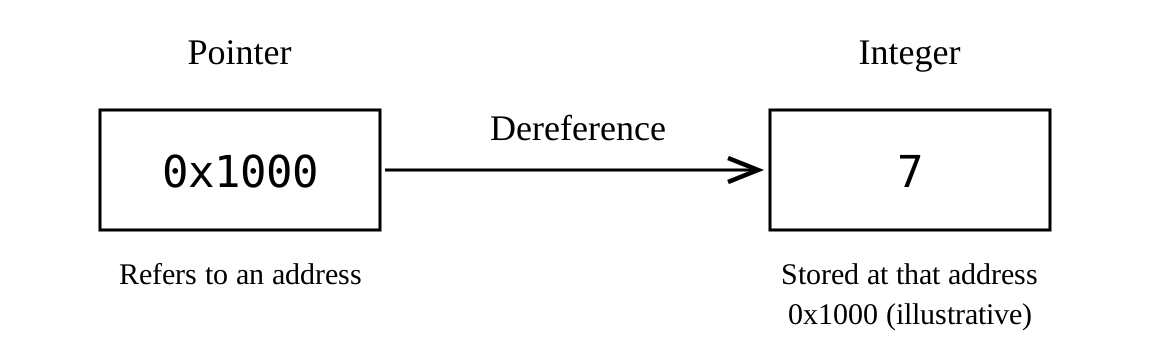
- Sometimes we need to share a piece of memory
- Pointers let us observe remote state, and possibly mutate it (woo, dangerous!)
Stack and heap
- The stack holds temporary storage for active function calls
- Each call adds a frame for its local data
- Returning from a call releases its frame
- The heap holds separate blocks allocated while the program runs
- A heap block lasts until released, possibly after the allocating call returns
Values and bindings
fn main() {
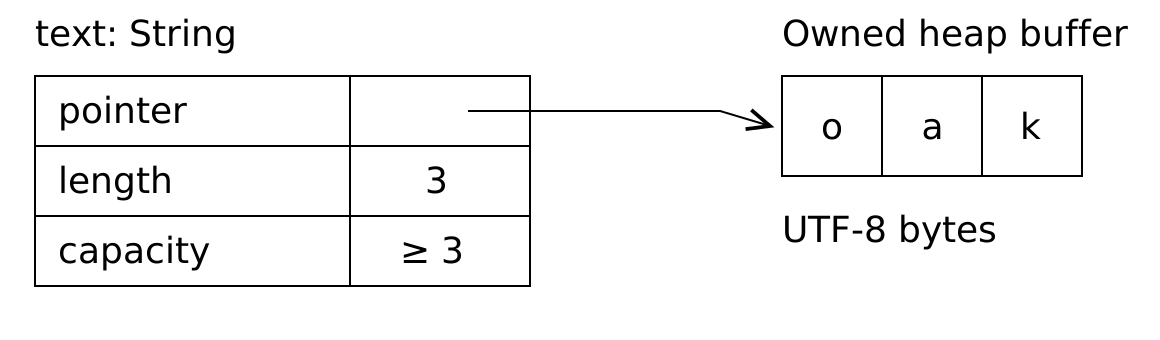
    let text = String::from("oak");
    println!("{}", text.len());
}- A local
textbinding containing aString - The
Stringowns a buffer of UTF-8 bytes
Owned storage
Storage and ownership
- Local values usually occupy space in the stack frame
StringandVec<T>own heap buffers- Ownership rules apply to heap-free values too
- The compiler decides storage placement and machine copies
Structs
struct Point { x: i32, y: i32 }
fn main() {
    let mut point = Point { x: 3, y: 4 };
    point.x += 1;
    println!("{} {}", point.x, point.y);
}- Local struct values normally live on the stack
- Field order in memory is unspecified by default
Ownership transfer
fn main() {
    let first = String::from("oak");
    let second = first;
    println!("{second}");
}- Assignment moves a non-
Copyvalue secondnow owns the string
String move
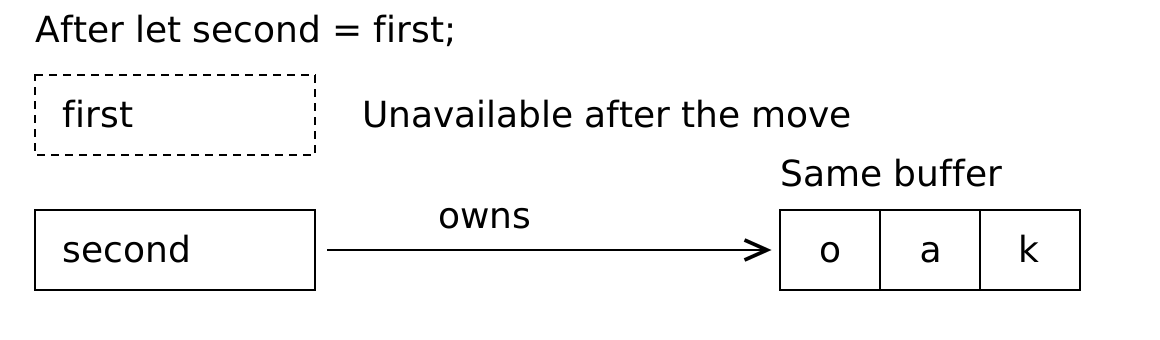
- Ownership transfer without duplicating the buffer
- The old binding has no value available for use or drop
Boxed values
fn main() {
    let first = Box::new(7);
    let mut second = first;
    *second += 1;
    println!("{second}");
}Box<T>owns a heap-allocatedT- Moving the box transfers ownership of the allocation
- Dropping the box drops
Tand releases the allocation
Moves without allocation
struct Token;
fn main() {
    let first = Token;
    let _second = first;
    let _third = first;
}Tokenis a unit struct with no fields- Even a zero-sized type is non-
Copyby default
Reinitialization
fn main() {
    let mut first = String::from("oak");
    let second = first;
    first = String::from("elm");
    println!("{first} {second}");
}- A moved binding can receive a new value
Owned parameters
fn byte_len(text: String) -> usize {
    text.len()
}
fn main() {
    let name = String::from("oak");
    println!("{}", byte_len(name));
}- The argument moves into the parameter, which is dropped on return
Return values
fn name() -> String {
    let text = String::from("oak");
    text
}
fn main() {
    let result = name();
    println!("{result}");
}- Returning the value transfers ownership to the caller
Implicit copies
fn main() {
    let first = 7;
    let mut second = first;
    second += 1;
    println!("{first} {second}");
}i32implementsCopy, so both bindings have usable values
Copy as a type property
- Implicit, bitwise duplication in value contexts
- Integers, floats,
bool,char, tuples and arrays ofCopyelements - Explicit implementation or derivation for user-defined types
- Type size and stack placement do not decide whether a type is
Copy
Derived Copy
#[derive(Clone, Copy)]
struct Pair(i32, i32);
fn main() {
    let first = Pair(3, 4);
    let second = first;
    println!("{} {}", first.0, second.1);
}Pairis a tuple struct with fields.0and.1- Every field must be
Copy, and the type cannot implementDrop
Explicit duplication
fn main() {
    let first = String::from("oak");
    let mut second = first.clone();
    second.push('s');
    println!("{first} {second}");
}String::clonecreates a separate owned buffer with the same contents
Move, copy, clone
- A move transfers ownership and makes the source value unavailable
- A copy duplicates the value implicitly
- A clone duplicates it through a type-defined operation
- Cloning may allocate or share a resource through a shared pointer
Partial moves
fn main() {
    let pair = (String::from("L"), String::from("R"));
    let left = pair.0;
    println!("{left} {}", pair.1);
}- Moving one field leaves the other field available
Whole value after a partial move
fn main() {
    let pair = (String::from("L"), String::from("R"));
    let _left = pair.0;
    println!("{pair:?}");
}- E0382 reports that the whole tuple is no longer available
Conditional moves
fn main() {
    let text = String::from("oak");
    if text.len() > 2 {
        let _taken = text;
    }
    println!("{text}");
}- A value must be available on every path reaching its use
Destruction
- Initialized local values are dropped at scope exit
- Local bindings are dropped in reverse declaration order
- Owned fields are dropped recursively
- Implement
Dropfor additional type-specific cleanup
Observable drop order
struct Trace(u8);
impl Drop for Trace {
    fn drop(&mut self) { print!("{} ", self.0); }
}
fn main() {
    let _outer = Trace(1);
    { let _inner = Trace(2); }
    print!("end ");
}- Inner scope first, then the remaining outer local
Early release
fn main() {
    let text = String::from("oak");
    drop(text);
    println!("{text}");
}std::mem::droptakes its argument by value- E0382 follows from transferring ownership into
drop
Replacement
struct Trace(u8);
impl Drop for Trace {
    fn drop(&mut self) { print!("{} ", self.0); }
}
fn main() {
    let mut value = Trace(1);
    value = Trace(2);
    print!("body ");
    drop(value);
}- Assignment drops the old value before storing the new one
Borrowed access
fn main() {
    let value = 7;
    let view = &value;
    println!("{} {value}", *view);
}Mutable references
fn main() {
    let mut value = 7;
    let view = &mut value;
    *view += 1;
    println!("{value}");
}
&mut Tprovides exclusive access and is notCopy- The reference binding itself need not be
mut
Methods
struct Counter { value: u32 }
impl Counter {
    fn value(&self) -> u32 { self.value }
}
fn main() {
    let counter = Counter { value: 7 };
    println!("{}", counter.value());
}- Define methods in an
implblock &selfborrows the receiver, automatically incounter.value()
Mutating methods
struct Counter { value: u32 }
impl Counter {
    fn increment(&mut self) { self.value += 1; }
}
fn main() {
    let mut counter = Counter { value: 7 };
    counter.increment();
    println!("{}", counter.value);
}
&mut selfrequires exclusive access to the receiver
Consuming methods
struct Label { text: String }
impl Label {
    fn into_text(self) -> String { self.text }
}
fn main() {
    let label = Label { text: String::from("oak") };
    let text = label.into_text();
    println!("{text}");
}selftakes the receiver by value, moving this non-Copylabel
Conflicting access
fn main() {
    let mut text = String::from("oak");
    let view = &text;
    text.push('s');
    println!("{view}");
}- E0502 reports shared access overlapping the mutable access in
push
Last use of a borrow
fn main() {
    let mut text = String::from("oak");
    let view = &text;
    print!("{view} ");
    text.push('s');
    println!("{text}");
}- The borrow can end after its last use, before the binding’s scope ends
Exclusive access
fn main() {
    let mut value = 7;
    let first = &mut value;
    let second = &mut value;
    println!("{first} {second}");
}- E0499 reports overlapping mutable borrows of the same value
Reborrowing
fn main() {
    let mut value = 7;
    let outer = &mut value;
    let inner = &mut *outer;
    *inner += 1;
    *outer += 1;
    println!("{value}");
}- Access through
outerresumes after the last use ofinner
Overlapping reborrows
fn main() {
    let mut value = 7;
    let outer = &mut value;
    let inner = &mut *outer;
    *outer += 1;
    println!("{inner}");
}- The later use of
innerkeeps its exclusive borrow active
Reference lifetime
fn main() {
    let view;
    {
        let text = String::from("oak");
        view = &text;
    }
    println!("{view}");
}- E0597 requires the referent to exist for every use of the reference
Sequence slices
fn main() {
    let values = vec![10, 20, 30];
    let tail = &values[1..];
    println!("{tail:?}");
}&[T]borrows contiguous elements and records their length- One owned buffer, accessed through a smaller view
Borrowed parameters
fn byte_len(text: &str) -> usize { text.len() }
fn main() {
    let owned = String::from("oak");
    let length = byte_len(&owned);
    println!("{length} {}", byte_len("elm"));
}- A
&strparameter accepts a borrowedStringor a string literal
Borrowed results
fn trimmed(text: &str) -> &str { text.trim() }
fn main() {
    let owned = String::from(" oak ");
    let view = trimmed(&owned);
    println!("{view}");
}- The result borrows the input without allocating a new string
- Lifetime elision relates the result to the single input borrow
Lifetime parameters
fn trimmed<'a>(text: &'a str) -> &'a str {
    text.trim()
}
fn main() {
    let owned = String::from(" oak ");
    println!("{}", trimmed(&owned));
}'anames the borrow lifetime shared by input and result- An annotation relates borrows without extending the owner’s lifetime
Lifetime elision
- Omitted lifetime parameters follow rules in the signature
- Each elided input lifetime gets a distinct parameter
- With exactly one input lifetime, elided outputs use that lifetime
- The function body is checked against the resulting signature
Ambiguous output lifetime
fn choose(left: &str, right: &str) -> &str {
    if left.len() >= right.len() { left } else { right }
}
fn main() {
    println!("{}", choose("oak", "elm"));
}- E0106 requires a lifetime for the result
- Neither input lifetime is selected by elision
Explicit output lifetime
fn choose<'a>(left: &'a str, right: &'a str) -> &'a str {
    if left.len() >= right.len() { left } else { right }
}
fn main() {
    let left = String::from("oak");
    println!("{}", choose(&left, "elm"));
}- Both inputs must be valid for the chosen
'a - The owners can have different scopes
Borrowing methods
struct Text { value: String }
impl Text {
    fn before(&self, separator: &str) -> &str {
        self.value.split(separator).next().unwrap()
    }
}
fn main() {
    let text = Text { value: String::from("oak,elm") };
    println!("{}", text.before(","));
}- The returned slice borrows
self, notseparator
Receiver lifetime elision
fn before(&self, separator: &str) -> &str

fn before<'a, 'b>(
    &'a self, separator: &'b str,
) -> &'a str- Equivalent method signatures inside
impl Text - With
&selfor&mut self, elided outputs use the receiver’s lifetime - Other borrowed arguments can have independent lifetimes
Ownership in signatures
fn inspect(text: &str) { /* shared access */ }
fn change(text: &mut String) { /* exclusive access */ }
fn consume(text: String) { /* owned input */ }
fn create() -> String { String::new() }
Ownership choices
- Borrow for temporary access
- Transfer ownership when the recipient needs the value
- Clone when a second owned value is needed
- Return an owned value for newly created data